
The solar system on the day you were born
On the day you were born, the solar system had a shape all its own: the eight planets and Pluto each stood at one point on its path around the Sun. You can see that arrangement free on our Live View, check it against NASA JPL's own simulator, and work out how far each world has moved since.
This guide explains what that picture shows, how to find it for any date that matters to you, and why the arrangement you were born under will not come back while you are here to see it. It is all astronomy: positions, distances and orbits, worked out from published NASA data.
What does "where the planets were" actually mean?
The question sounds simple, but there are two honest answers, depending on where you stand to look.
The view from above the Sun
Imagine floating far above the solar system, looking down on it. The Sun sits in the middle. Each planet follows its own nearly circular path around it, and all of them move the same way round, counterclockwise as seen from the north. On any given day, each world lies in one particular direction from the Sun.
Astronomers call that direction a planet's heliocentric longitude: heliocentric because it is measured from the Sun, longitude because it is an angle around a circle, from 0 to 360 degrees. Put all nine directions together and you have a single picture of the whole solar system on one date. Earth is just one dot in it, on the third ring out.
This top-down view works because the solar system is surprisingly flat. According to NASA's planetary fact sheet, every planet's orbit is tilted less than 3.5 degrees from Earth's, except Mercury at 7 degrees. Pluto tilts more, about 17 degrees. Flatten the whole thing onto a page and very little is lost.
The view from your own sky
The second answer is what you would have seen if you had stepped outside that day. This is the geocentric view, measured from Earth. Because Earth is moving too, and because we look out at the other planets from one spot on a moving planet, the sky tells a different story from the top-down picture.
From Earth, all the planets lie close to one path across the sky, the ecliptic, which is the same flatness seen edge-on. A planet in roughly the same direction as the Sun is lost in daylight. A planet on the far side of Earth from the Sun is up all night. Mercury and Venus, whose orbits sit inside ours, never wander far from the Sun in our sky: between 1900 and 2050, Mercury never gets more than about 28 degrees from it and Venus never more than about 47. That is why you only ever catch them in the evening or morning twilight.
Both views describe the same day. The top-down one shows where everything really was. The sky view shows what that arrangement looked like from home. The stars behind them barely shift over a lifetime, which is why a sight like the Milky Way core looks the same to you as it did to your grandparents. The planets are the part of the sky that changes. If you are weighing a picture of the stars against a picture of the planets, our guide to star maps vs planet prints sets the two side by side.
Astronomy, not astrology
Search for "where were the planets when I was born" and much of what comes back is astrology: birth charts, signs and readings. Plenty of people enjoy those. This guide is something else. It deals only with physical positions you can measure and check against NASA, and it gives no meanings to them. The planets on your birthday are a fact about the solar system, and a lovely one. What you make of that fact is yours.
How can you see the solar system on your own date?
You don't need software, an account or any astronomy background. Two free pages on our site do the work.
Watch it on the Live View
Our Live View lets you pick any date from 1900 to 2100. Choose the day, and you watch the planets move around the Sun to where they stood on it, from Mercury out to Pluto. You can add a few words and send it to someone as a link. They just open it: no app or account needed. Positions are calculated from NASA JPL's published orbital data, the same calculation we use for our prints.
A few things worth looking for once your date is on screen:
- Which worlds are bunched together. Two or three planets sharing one side of the Sun is common and often striking.
- Which side of the Sun Earth is on. Earth's spot is set by the time of year, so everyone born in the same week shares nearly the same Earth.
- The slow outer worlds. Neptune and Pluto barely move from one year to the next, so they are the part of the picture that most belongs to your decade.
Check it against NASA JPL
If you'd rather not take anyone's word for it, our verify page walks you through checking a date against NASA JPL's Solar System Simulator, a public tool run by NASA's Jet Propulsion Laboratory that draws the solar system as seen from above. You can have the page fetch NASA's picture for you, or follow along step by step and fill in NASA's form yourself. NASA's form accepts years from 1970 to 2050; for other years, use the first option.
The comparison itself takes seconds. Find the Sun in the middle of both pictures, pick a planet and note which way it lies from the Sun, then find the same planet on NASA's picture. It sits in the same direction. The distances differ, and that is expected: NASA draws true distances, so the inner planets crowd into the Sun's glare, while our pictures space the rings evenly so every world fits.
How close is close? Each planet's position is calculated from NASA JPL's published orbital data. On a 16x20 print, every planet sits within half a millimeter of NASA JPL's reference position, for any date from 1900 to 2050.
How far has each planet traveled since you were born?
Every world has kept moving since your birthday, each at its own pace. The inner planets lap the Sun quickly. The outer ones crawl. The table below uses the sidereal orbital periods from NASA's individual planet fact sheets to show how far each one travels.
| World | One trip around the Sun | Degrees around the Sun per year | Orbits in 30 years |
|---|---|---|---|
| Mercury | 88 days | 1,495° | 124.6 |
| Venus | 225 days | 585° | 48.8 |
| Earth | 365.26 days | 360° | 30.0 |
| Mars | 1.88 years | 191° | 16.0 |
| Jupiter | 11.86 years | 30.3° | 2.5 |
| Saturn | 29.45 years | 12.2° | 1.0 |
| Uranus | 84.0 years | 4.3° | 0.36 |
| Neptune | 164.8 years | 2.2° | 0.18 |
| Pluto | 247.9 years | 1.5° | 0.12 |
Periods from NASA's planetary fact sheets (sidereal orbit period). Degrees per year and orbits in 30 years are averages; planets on oval orbits speed up near the Sun and slow down far from it.
Read down the last column and the solar system splits in two. If you are 30, Mercury has gone round more than 124 times since you were born. Saturn has made just over one lap, which is why it sits close to where it was on your birthday. (Saturn's slow pace is also part of the story in our piece on how thin Saturn's rings are.) Neptune has covered less than a fifth of its path.
Earth: the one that comes back every year
Earth's row hides something easy to miss. A birthday is, quite literally, Earth arriving back at the same place in its orbit. Our calculation with NASA JPL's DE421 ephemeris shows that on June 15 of every year from 1990 to 2026, Earth's direction from the Sun stayed within a single degree. The calendar is built around this one orbit, which is why your birthday falls when it does.
It is also a long way to go. NASA's fact sheet gives Earth's average orbital speed as 29.78 kilometers per second. Over a year that adds up to about 584 million miles, so by your 30th birthday Earth has carried you roughly 17.5 billion miles around the Sun.
The same steady return explains why meteor showers keep to the calendar. As NASA puts it, showers occur as Earth passes through the trail of dusty debris left by a comet, and Earth crosses each trail at the same point in its orbit every year. Our meteor shower calendar lists when each one peaks.
Neptune: one orbit since it was found
At the other end of the table, Neptune makes a good reality check. It was discovered in 1846, and it took until 2011 to come back to the spot where it was first seen. NASA notes that in 2011 Neptune completed its first 165-year orbit since its discovery. Our own calculation from JPL's published orbital elements puts the return in July 2011, which matches NASA's Hubble release marking the anniversary on July 12, 2011. In all the time people have known Neptune exists, it has been round the Sun once.
Uranus, found in 1781, has gone round not quite three times since. Pluto, discovered in 1930, has covered a little over half of one orbit, about 195 degrees by our calculation. Pluto has moved faster than its average in that time because its oval orbit brought it in closer to the Sun.
Will the planets ever line up the same way again?
Not in your lifetime, and the reason is easy to show without any hand-waving.
The slow worlds settle it
Look again at Neptune and Pluto. Neptune needs about 165 years to come back to any given direction, and Pluto about 248. In a full century, Neptune moves only about 218 degrees around the Sun and Pluto about 145. So no matter where the faster planets happen to be, a human lifetime is far too short for those two to return to where they were on the day you were born. The full arrangement cannot repeat while you are alive, because two of its pieces won't have finished their laps.
Why the pattern doesn't simply loop
There is a deeper reason too. For the whole picture to repeat, you would need a span of time that is a whole number of orbits for every world at once. Mercury's period is about 0.24 years, Venus's 0.62, Mars's 1.88, Jupiter's 11.86, and so on. Those numbers don't divide neatly into one another, so there is no tidy number of years after which every planet is back where it started.
A few pairs do come close, and they are fun to know:
- Venus and Earth: eight Earth years hold almost 13 Venus orbits (13.004), so the two return near the same places every eight years.
- Jupiter and Saturn: five Jupiter orbits take about 59.3 years, and two Saturn orbits about 58.9.
- Neptune and Pluto: three Neptune orbits take about 494 years, and two Pluto orbits about 496.
Each near-match is slightly off, the mismatches build up over time, and they don't line up with one another. The orbits themselves also drift slowly, which is why JPL's published orbital elements include rates of change for every planet. The result is a pattern that never repeats in full.
How close does it ever get?
We tested this for the example date in the next section, June 15, 1990. Using NASA JPL's DE421 ephemeris, we checked every day from 1900 to 2050 to see when the planets came back near their June 15, 1990 directions.
- Even the four inner planets alone, Mercury, Venus, Earth and Mars, never again all sit within 15 degrees of those directions. The two nearest misses, in June 1958 and June 2022, still leave at least one of them more than 18 degrees off.
- Add Jupiter and Saturn, and no day in those 151 years brings all six within 20 degrees.
- Count all nine worlds, and the best any other day manages still leaves at least one of them about 55 degrees out of place.
So when people say the sky on your birthday was a one-off, this is what they mean in plain numbers. Planetary alignments, when several planets appear close together, do happen, but they are a different thing; our explainer on what a planetary alignment is covers how often they come around.
An example date, worked through: June 15, 1990
To make all this concrete, here is one date worked through in full. It is an example chosen for illustration, not anyone's real birthday. We computed each world's direction from the Sun with NASA JPL's DE421 ephemeris, and what it looked like from Earth on the same day.
| World | Direction from the Sun | In Earth's sky that day |
|---|---|---|
| Mercury | 0° | Low in the morning twilight |
| Venus | 355° | Bright in the morning sky |
| Earth | 264° | Home |
| Mars | 327° | In the morning sky |
| Jupiter | 110° | Low in the evening twilight, near the Sun's glare |
| Saturn | 291° | Up most of the night |
| Uranus | 278° | Up most of the night, at the edge of naked-eye visibility |
| Neptune | 283° | Up most of the night, too faint to see without optics |
| Pluto | 227° | In the evening half of the sky |
Directions are heliocentric ecliptic longitudes in degrees, measured around the Sun from the fixed reference direction astronomers use (the equinox of the year 2000), increasing in the direction the planets travel.
From above the Sun
Seen from above, June 15, 1990 has a clear shape. Saturn, Uranus and Neptune sit within about 14 degrees of one another, a tight cluster on the outer rings, just ahead of Earth's own direction from the Sun. Mercury, Venus and Mars bunch together too, all three within 34 degrees, roughly a quarter turn further on. Jupiter is on its own on the far side of the Sun from Earth. Pluto sits off by itself, a little behind Earth.
That close grouping of the three outer giants is the detail that dates this picture. Because they move so slowly, the three stayed within 20 degrees of one another from the spring of 1987 to the spring of 1991, and anyone born in those years shares some version of it. The inner planets are what make the day itself distinct: move this date one week later and Mercury shifts by about 37 degrees.
From Earth
From the ground, the same arrangement turns into a sky story. With Saturn, Uranus and Neptune almost in line with Earth's direction from the Sun, they were on our night side, up for most of the night. Saturn was easy to see. Uranus was the faint kind of target that NASA describes as just barely visible to people with excellent eyesight under dark skies, and Neptune, the only planet NASA notes is never visible to the naked eye, needed optics.
Venus, Mercury and Mars, a quarter turn ahead of Earth, sat on the morning side of the Sun, so they rose before dawn: Venus shining brightly, Mars farther from the Sun, and Mercury low in the twilight. Jupiter, on the far side of the Sun, was slipping into the evening glare. Someone born that day arrived under a night sky with Saturn up for most of it and a bright Venus before sunrise.
Try the same exercise with your own date on the Live View. Note which worlds cluster, where Earth sits, and which planets were on the night side, and you can describe your birthday sky with just as much confidence.
How do people keep a date like this?
Once you have seen the solar system on a date that matters, it is natural to want to hold on to it. Some people simply send the Live View link to the person it belongs to. Others want something to keep, and this is where we come in.
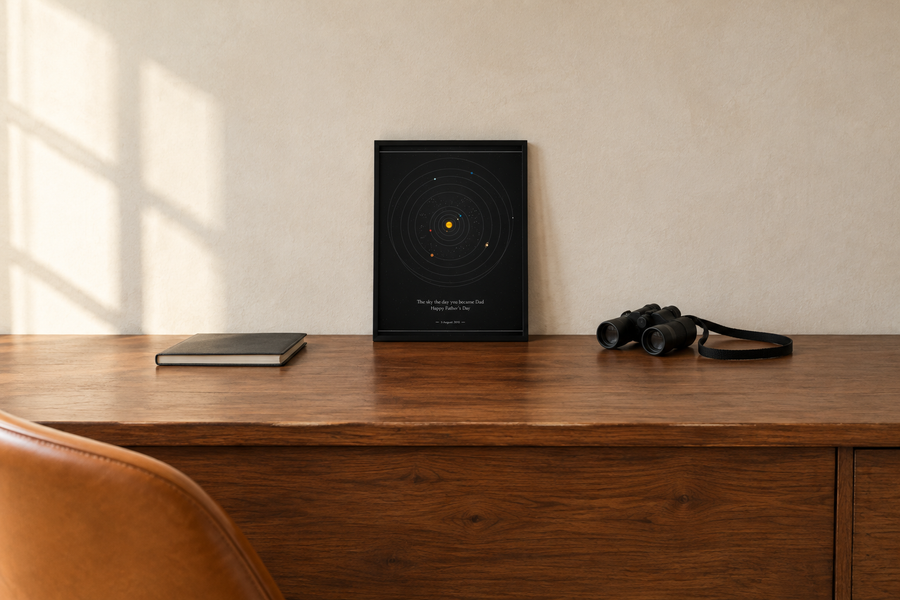
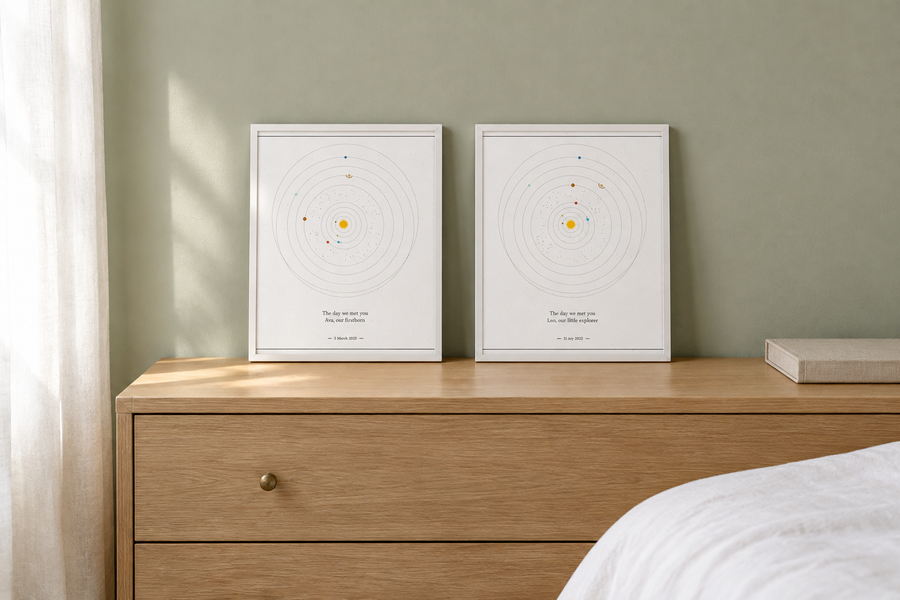
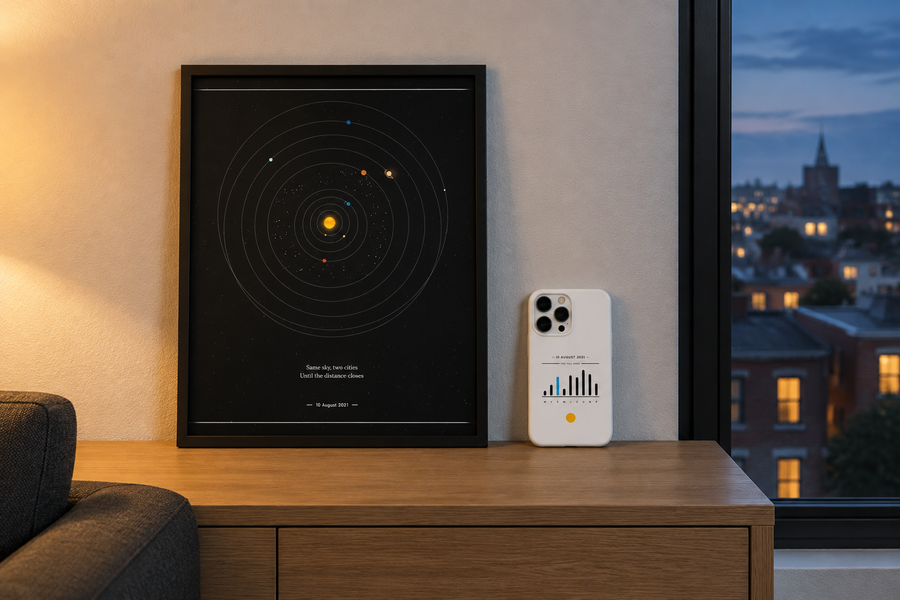
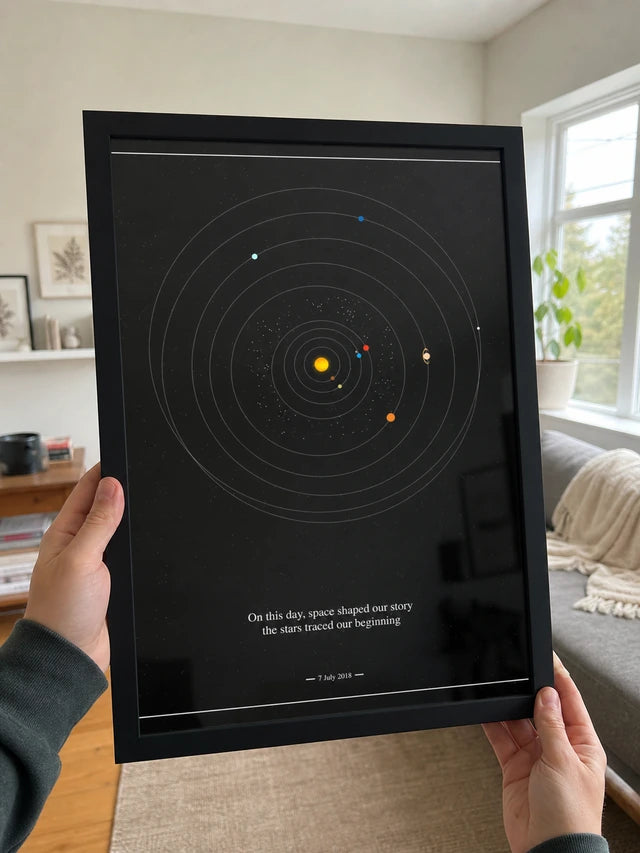
The Date Print shows the solar system from above on the date you choose: the Sun at the center and the eight planets and Pluto, each on its own ring, with the rings evenly spaced so every world fits. It carries the date and, if you like, a short message on two lines. It comes in a Black or a White edition, framed, frameless or as a digital file, and takes any date from 1900 to 2100. Only the date is needed, with no time or place.
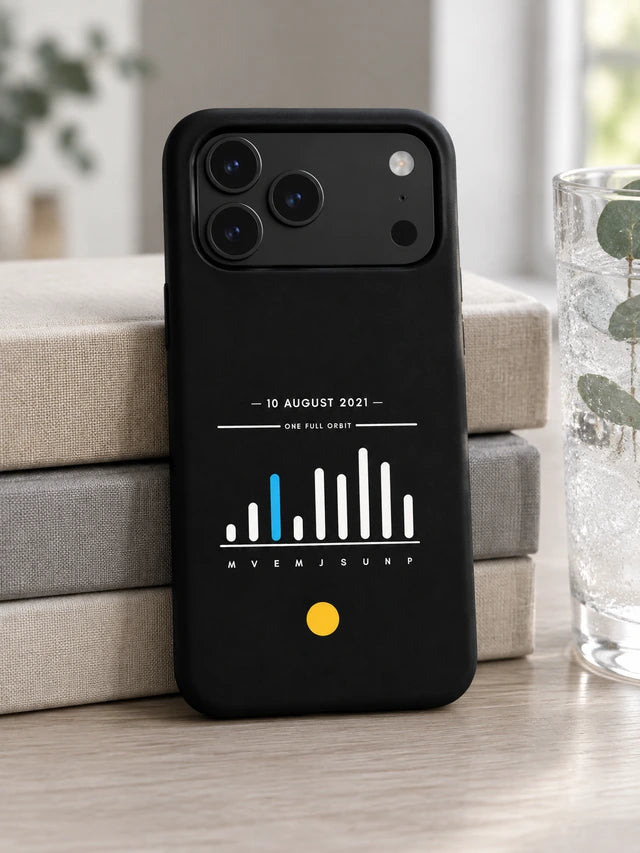
The Sky Code Case writes the same date as nine bars, one per world, each showing how far round the Sun that world had traveled. It is the table above, turned into something you carry every day, for dates from 1900 to 2050.
If you are choosing for someone else, our gift guides are organized by occasion: a birthday, a new baby, an anniversary or a memorial for someone you miss. If it is a first anniversary, our paper anniversary gift ideas are a good place to start. For a parent, there are Mother's Day gifts that hold a family date and Father's Day gifts for a dad who loves space.
Whichever you choose, the first step is the same: find your date and look. See the solar system on your date, and if it feels like yours, keep it.
Questions people ask
Do I need my birth time or place?
Not for the view from above the Sun. The planets' directions from the Sun change slowly enough that the date alone fixes the picture: even Mercury, the fastest, averages only about 4 degrees a day. Your location doesn't change the top-down view at all. Time and place matter only for the sky view, where they decide which planets were above your horizon at a given hour.
Is this the same as a birth chart?
No. A birth chart is an astrological tool that gives meanings to planetary positions. This guide, the Live View and the Date Print show physical positions only, calculated from NASA JPL's published orbital data, and they make no claims about what those positions mean for you.
Why is Pluto included if it isn't a planet?
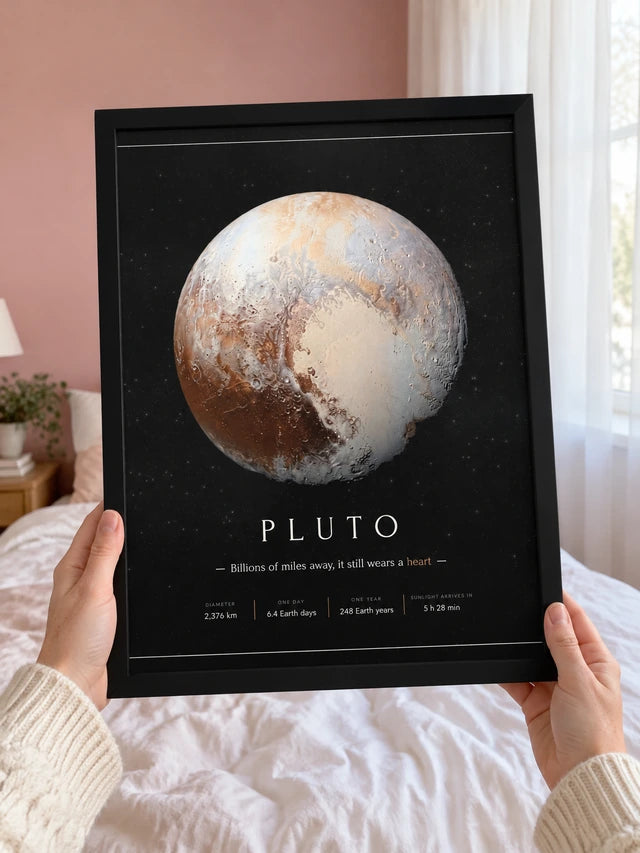
The International Astronomical Union reclassified Pluto as a dwarf planet in 2006, so the solar system has eight planets. Many people still think of Pluto as part of the family, and its slow 248-year orbit makes it one of the most telling parts of any date's picture, so we show the eight planets and Pluto.
Which dates can I look up?
The Live View and the Date Print take any date from 1900 to 2100, and the Sky Code Case takes dates from 1900 to 2050. NASA's simulator form, used on our verify page, covers 1970 to 2050 if you fill it in yourself.
Were the planets "aligned" on my birthday?
Probably not in the strict sense, but you may well find two or three planets bunched on one side of the Sun. Our guide to planetary alignments explains what the word means to astronomers and how often a real gathering happens.