
Gifts for a long-distance couple: one date, two places
The best gifts for a long-distance couple are ones you share at the same time, or ones that hold the same date for both of you. Daily-touch gadgets and letters help with the in-between; a shared date, like the day you met or the day you'll close the distance, gives two homes the same thing to look at.
Many long-distance gifts promise that you are "under the same sky". That is only partly true, and the true part makes a better gift.
Are you under the same sky when you're apart?
Not quite. Which stars are above you depends on where you stand and what time it is on your clock. What you do share is the solar system: on any date, the planets sit in one arrangement around the Sun, the same for both of you.
What changes from city to city
Take an example couple, one in Toronto and one in Vancouver, on Valentine's Day 2027. At 10 pm in Toronto it is 8 pm in Vancouver. (British Columbia stopped changing its clocks in 2026, so the gap is two hours in winter and three in summer.)
At that one moment, the two skies look quite different. We worked them out from NASA JPL's planetary data:
- In Toronto it is fully dark. Jupiter shines about 50 degrees up in the southeast, Mars is a little lower in the east-southeast, and Sirius sits in the south. Saturn has already set.
- In Vancouver the last of the twilight is still fading in the west. Jupiter is only about 20 degrees up in the east, and Saturn is still well above the west-southwest horizon.
Wait two hours for Vancouver's own 10 pm and the views come close, because the sky turns about 15 degrees an hour for everyone. The North Star still sits higher for the partner farther north: about 50 degrees up in Vancouver, 44 in Toronto. And if one of you is in the Southern Hemisphere, the difference is larger. From Sydney, the North Star never rises at all.
One thing you do see alike is the Moon's phase. On that evening it is a little more than half lit for both of you, though it hangs high in the west for one and high in the south for the other.
What stays the same for both of you
Step back from Earth and look down on the solar system, and location drops out. A planet's position around the Sun is worked out in Sun-centered coordinates, from its orbit and the date. NASA JPL's method for the approximate positions of the planets takes the time as its input and gives a position relative to the Sun. No observer appears anywhere in it, so the answer is the same in Toronto, Vancouver or Sydney.
Even the clock barely matters. In the two hours between 10 pm in Toronto and 10 pm in Vancouver, Mercury, the fastest planet, moves less than half a degree around the Sun, and the others far less. Late in the evening a long-distance couple may not even share a calendar date: 11 pm on February 14 in Vancouver is 1 am on February 15 in Toronto. Across that whole day, Mercury moves less than 6 degrees and Venus under 2, while Jupiter and the planets beyond move less than a tenth of a degree. The date you both name holds the same picture for both of you.
| Same for both of you? | |
|---|---|
| Which stars are up at a given moment | No: it depends on latitude and local time |
| When it gets dark | No: it depends on where you are in your time zone and the season |
| The Moon's phase on a given night | Yes, though it sits in a different part of each sky |
| The planets' arrangement around the Sun on a date | Yes |
So the honest version of the line is: not the same stars at the same moment, but the same planets on the same day. Our guide to what "where the planets were" means explains that picture in more depth.
What are good gifts for feeling close every day?
These fill the ordinary days between visits. None of them is ours; they are categories worth knowing.
- Connected touch lamps. A pair of lamps, one in each home: touch yours and the other lights up.
- Message boxes and touch bracelets. Small devices that pass a note, a tap or a heartbeat between you. Most need Wi-Fi or a phone app, so check they will work in both homes.
- "Open when" letters. A bundle of sealed letters for particular moments: open when you can't sleep, when you've had a hard day, when you're counting the days.
- A shared book or series. Two copies of the same book, or one show you only watch together on a call.
- A care package from your city. The coffee, the snack and the postcard from the places you go together when you visit.
What gifts hold a date you share?
A date is the one thing both of you own outright, wherever you are. Three tend to matter most to long-distance couples:
- The day you met, often in the same city, before the distance began.
- The first visit, when the distance first felt crossable.
- The day you'll close the distance, a moving day or a start date. A date still to come works too.
Our guide to choosing the date for a couple's gift helps if you can't agree on which one.
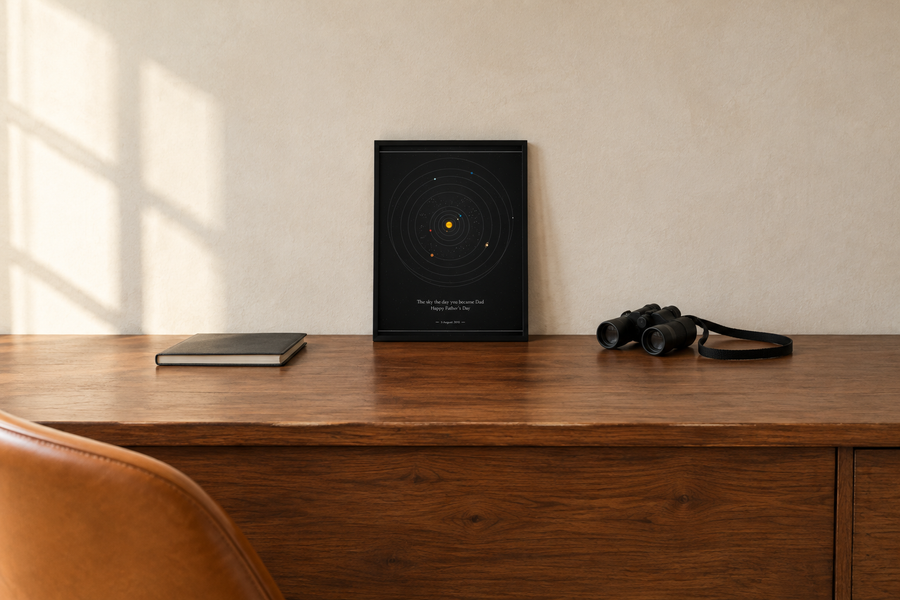
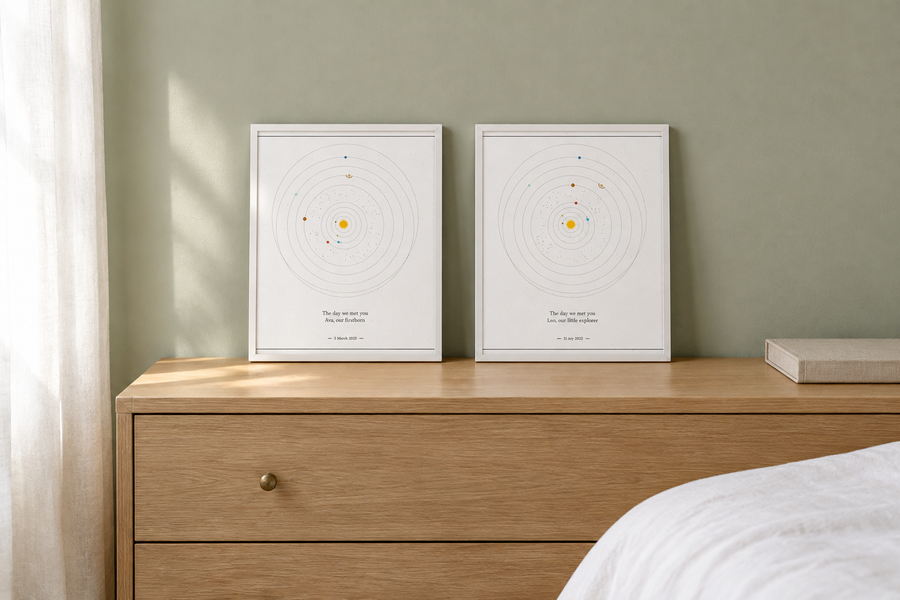
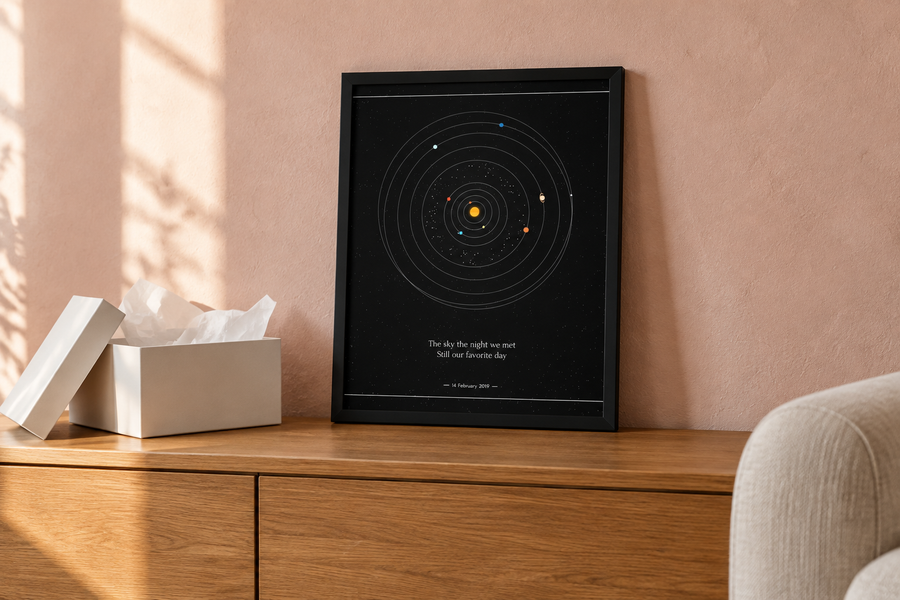
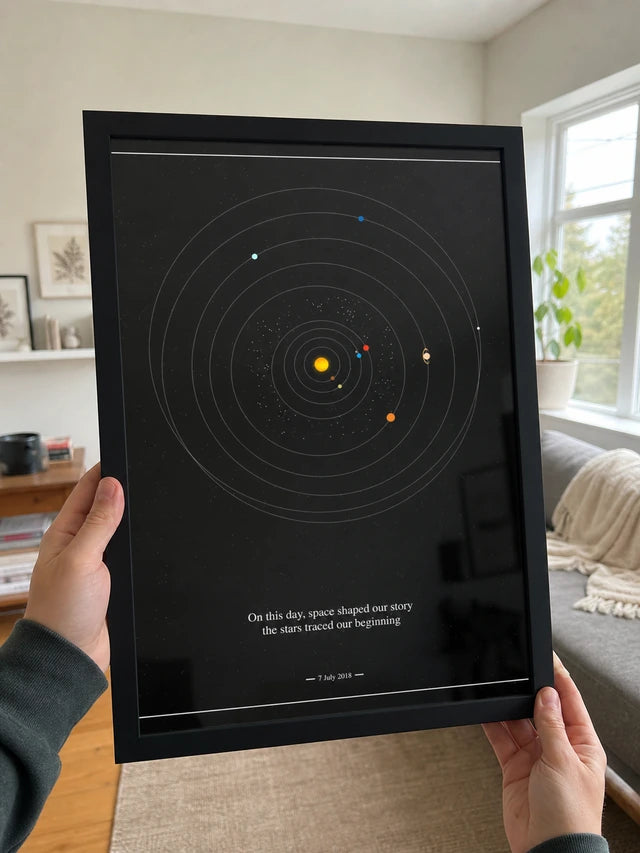
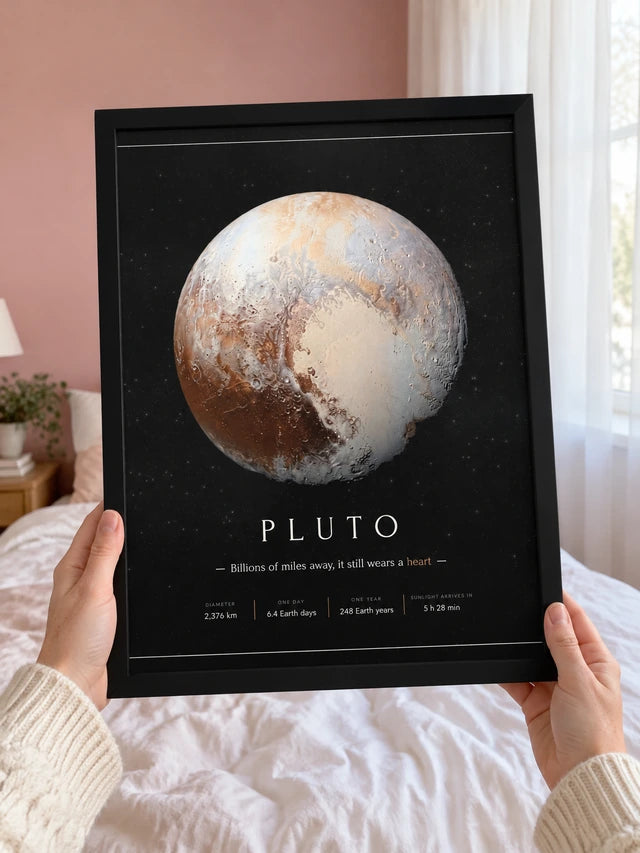
For a date gift you can both keep, think in pairs: one for each home. Two prints of the same date mean you look at the same picture from different walls, and the Date Print suits this well because it needs only the date, never a place. You could keep the date the same and let the words differ, for example "Toronto to Vancouver / same planets, same day" on one and the cities reversed on the other.
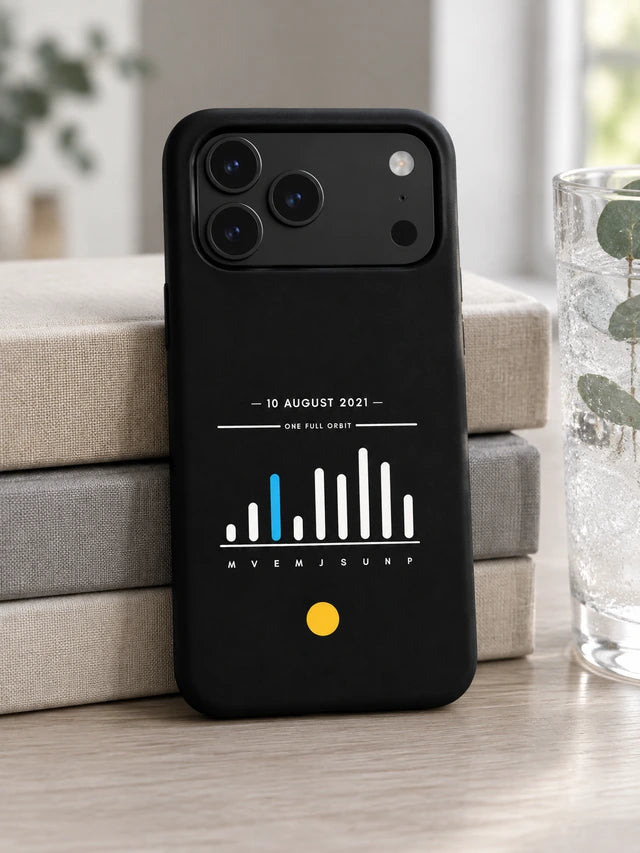
Two Sky Code Cases do the same in a pocket: one date written as nine bars, one per world, identical on both phones. A star map is lovely too, but it has to choose one city's sky, so a pair would show two different skies. Our star map vs planet print comparison sets out what each shows.
What can you give for the countdown and the next visit?
- A shared countdown. One calendar you can both see, with the next visit marked and the plans filled in.
- The visit itself, planned. A booked dinner, a day trip, or the ticket.
- A print of the reunion date. The Date Print covers dates to 2100, so the day you'll live in one place can go on the wall before it happens.
- Something to finish together. A puzzle, a recipe you'll cook on the first night, or a photo album with the last pages left blank.
Valentine's Day is often the hardest date to spend apart. Our meaningful Valentine's Day gift ideas cover timing and what to write.
How do you send a gift across the country or the border?
- Prints: made to order in 2 to 5 business days, then free shipping to the US and Canada. Most arrive within 1 to 2 weeks.
- Phone cases: made in the United States and shipped free. They reach US addresses in about 1 to 2 weeks and Canadian addresses in about 2 to 5 weeks, so allow extra time for a partner in Canada.
- One for each of you: to send a matching pair to two homes, place one order for each address.
- The digital file: the Date Print as a high-resolution file, emailed in 24 to 48 hours. Forward it, and your partner can print it locally the same day.
- Free and immediate: send the sky of your date with Live View. Your partner opens a link, with no app or account, and watches the planets move to where they stood that day.
One date, two places
Distance changes which stars you see and when the night begins. It doesn't change where the planets were on the day that matters to you both.
The Date Print draws that day: the Sun, the eight planets and Pluto on their rings, the date beneath and up to 80 characters of your own words, in Black or White, framed, frameless or as a digital file. Each planet's position is calculated from NASA JPL's published orbital data, and you can compare it with NASA JPL's own simulator. For a pocket instead of a wall, the Sky Code Case carries the same date. Create your print, one for each home.