

The 2027 night sky from North America: what's worth going out for
Updated October 2026.
In 2027 the big eclipses happen elsewhere, so North America's best sky events are the planets: Jupiter and Mars at opposition in February, Saturn in October, and Venus passing Mars on November 24. Add three dark-sky meteor peaks and a sunrise partial eclipse for Atlantic Canada on August 2.
This is a short list, not a database. Most events below need only your eyes or binoculars, from most of the US and Canada. Where a famous 2027 event can't be seen from here, we say so.
What are the best sky events of 2027 in North America?
Times are Eastern and Pacific (US). British Columbia now stays on summer time all year, so in winter its clocks read an hour later than US Pacific time.
| Date | Event | How to see it | Worth it? |
|---|---|---|---|
| Jan 3 | Venus at its greatest distance from the Sun in the morning sky | Naked eye, southeast before dawn, far brighter than any star | Good |
| Jan 3 to 4 | Quadrantid meteors, with a thin Moon | Naked eye, after 1:30 am until dawn | Top pick |
| Feb 10 | Jupiter at opposition | Naked eye, rises at sunset, up all night in Leo | Top pick |
| Feb 19 | Mars at opposition and closest to Earth; the nearly full Moon beside Jupiter | Naked eye, east after dusk | Top pick |
| Feb 20 | Penumbral lunar eclipse at moonrise | East only: the Moon rises faintly shaded, low in twilight | Keen observers |
| May 5 to 6 | Eta Aquariid meteors at new Moon | Naked eye, the last hour or two before dawn | Good, best in the south |
| Late May | Mercury's best evening showing | Naked eye or binoculars, low in the west-northwest after sunset | Good |
| Jul 30 to Aug 1 | Southern Delta Aquariid and Alpha Capricornid meteors, near new Moon | Naked eye, midnight to 4 am | Top pick |
| Aug 2 | Partial solar eclipse at sunrise | Atlantic Canada only, with eclipse glasses | Top pick if you are there |
| Aug 10 | The Moon about 1° from Antares | Naked eye, south after dusk | Good |
| Aug 12 to 13 | Perseid meteors, with moonlight until about 2:30 am | Naked eye, before dawn | Good |
| Sep 20 to 21 | The Moon passes over the Pleiades, hiding some of its stars | Binoculars, late evening, best from the East and Midwest | Good |
| Oct 17 | Saturn at opposition | Naked eye, up all night in Pisces; a small telescope shows the rings | Top pick |
| Nov 24 | Venus and Mars less than a full Moon's width apart | Naked eye or binoculars, low in the southwest at dusk | Top pick |
| Nov 30 | A crescent Moon with Venus and Mars | Naked eye, southwest at dusk | Good |
| Dec 30 | A crescent Moon 2.5° from Venus | Naked eye, southwest at dusk | Good |
Separations were calculated for cities from New York to Vancouver and vary a little by place.
Can you see the 2027 solar eclipses from North America?
Mostly no. Neither of 2027's two solar eclipses reaches the United States, and one clips the far east of Canada at sunrise.
February 6: annular eclipse
The "ring of fire" path crosses Chile, Argentina and the South Atlantic, and the partial phase covers much of South America, Antarctica and western and southern Africa. No part of the US or Canada sees any of it.
August 2: total eclipse
Totality crosses Spain, Morocco, Algeria, Libya, Egypt, Saudi Arabia, Yemen and Somalia, and lasts up to 6 minutes 23 seconds, in southern Egypt.
From North America, only Atlantic Canada sees anything, and only at sunrise. We checked this with NASA's own eclipse calculator:
- Newfoundland: the Sun rises already partly eclipsed. In St. John's, the Moon covers about 40% of the Sun's width at its deepest, around 6:10 am NDT, with the Sun just 4° up. It ends around 6:50 am.
- Nova Scotia and Prince Edward Island: the Sun rises with a bite already taken out of it, about a quarter of its width in Halifax and a little more on Cape Breton Island. It ends around 6:20 am ADT.
- New Brunswick: only a small notch at sunrise in Saint John, gone within minutes.
- The US: nothing. In easternmost Maine the eclipse ends just as the Sun comes up.
You need a clear view of the eastern horizon. NASA's rule holds even for a low Sun: during a partial eclipse it is never safe to look directly at the Sun without proper eye protection, meaning eclipse glasses or a handheld viewer made to the ISO 12312-2 standard. Sunglasses are not enough. See NASA's eclipse safety guide.
Are any 2027 lunar eclipses visible from North America?
All three lunar eclipses in 2027 are penumbral: the Moon passes only through the faint outer part of Earth's shadow and never turns red. NASA's eclipse site says skilled observers need about 0.6 of the Moon's width inside that outer shadow before they can detect any shading.
- February 20: the deepest of the three, with 0.93 of the Moon's width inside the outer shadow. Greatest eclipse is at 6:13 pm EST, just after moonrise in the East. From New York and Montreal the Moon is about 6° up in twilight, and you may catch a gray shading on one edge. Chicago sees only the fading end, and the West Coast nothing. That evening the full Moon rises about 2° from Regulus, with Mars about 6° away.
- July 18: not visible from North America. It happens in daylight here, and only a sliver of the Moon touches the shadow.
- August 17: visible across all of North America, greatest at 3:13 am EDT (12:13 am PDT), but only 0.55 of the Moon's width enters the outer shadow. That is below the level skilled observers need, so expect an ordinary full Moon.
For every full Moon of the year and its traditional name, see our full Moon names and dates.
What are the best meteor showers of 2027?
- Quadrantids, January 3 to 4: the thin Moon stays out of the way. The radiant is well up from about 1:30 am until dawn.
- Eta Aquariids, May 5 to 6: the new Moon gives the darkest possible sky, but only the last hour or two before dawn works, and the shower favors the southern US.
- Southern Delta Aquariids and Alpha Capricornids, July 30 to August 1: two showers under a nearly moonless sky. The same new Moon makes this a good stretch for the summer Milky Way, which our Milky Way core guide covers month by month.
Two big showers meet a bright Moon. The Perseids on August 12 to 13 are lit until the Moon sets around 2:30 am, so go out before dawn. The Geminids on December 14 to 15, usually the year's best, meet a nearly full Moon. Every peak, with moonlight ratings, is in our meteor shower calendar.
When are the planets best placed in 2027?
At opposition, Earth passes between a planet and the Sun. The planet rises at sunset, stays up all night and is at its brightest.
| Planet | Opposition | Where | How to see it |
|---|---|---|---|
| Jupiter | Feb 10, 7:28 pm EST (4:28 pm PST) | Leo | Naked eye, the brightest planet of the evening |
| Mars | Feb 19, 10:50 am EST (7:50 am PST) | Leo, near Regulus | Naked eye, a bright orange point |
| Neptune | Sep 28 | Pisces | Not visible to the naked eye; use a telescope |
| Saturn | Oct 17, 8:35 pm EDT (5:35 pm PDT) | Pisces | Naked eye; rings need a small telescope |
| Uranus | Nov 30 | Taurus | Binoculars, from a dark site |
Mars and Jupiter in February
Jupiter and Mars sit about 10° apart in Leo, both up all night. Mars is closest to Earth on the evening of February 19, about 101 million km (63 million miles) away. This is a small opposition, though: Mars is near the far point of its orbit, so through a telescope it looks just over half as wide as it can at its best. On that same evening the nearly full Moon rises beside Jupiter, about 1.5° from it as seen from the West and about 3° from the East.
Saturn in October
Saturn reaches opposition on October 17 in Pisces, an easy naked-eye sight all night. Its rings are tilted about 13° toward us, showing their southern face, after turning edge-on to us in March 2025. Our guide to whether Saturn's rings are disappearing explains why that tilt changes.
Venus and Mercury
Venus starts the year as the morning star, 47° from the Sun on January 3 and near its brightest for the year. It passes behind the Sun on August 11, then climbs into the evening sky. On November 24 it passes Mars, 0.3° apart, less than the width of a full Moon. The pair is low, about 9° up at the end of civil twilight from New York or Chicago and 12° from Los Angeles or Dallas, so find a clear southwest horizon. Mars is far fainter than Venus, and binoculars help. A crescent Moon joins them on November 30, and sits 2.5° from Venus on December 30.
Mercury never strays far from the Sun. Its best evening showing for the US and Canada is in late May, when it stands about 13° up in the west-northwest at the end of civil twilight. Its best morning showing is in early November, about 12° up in the east-southeast before sunrise.
You may see 2027 "planet parade" dates online. By our planetary alignment guide's count, no four bright planets share the twilight sky from mid-northern latitudes in 2027; the next such window is in January 2028.
When are the 2027 equinoxes and solstices?
- March equinox: March 20, 4:25 pm EDT (1:25 pm PDT)
- June solstice: June 21, 10:11 am EDT (7:11 am PDT)
- September equinox: September 23, 2:02 am EDT (September 22, 11:02 pm PDT)
- December solstice: December 21, 9:42 pm EST (6:42 pm PST)
A date in 2027 you're already waiting for
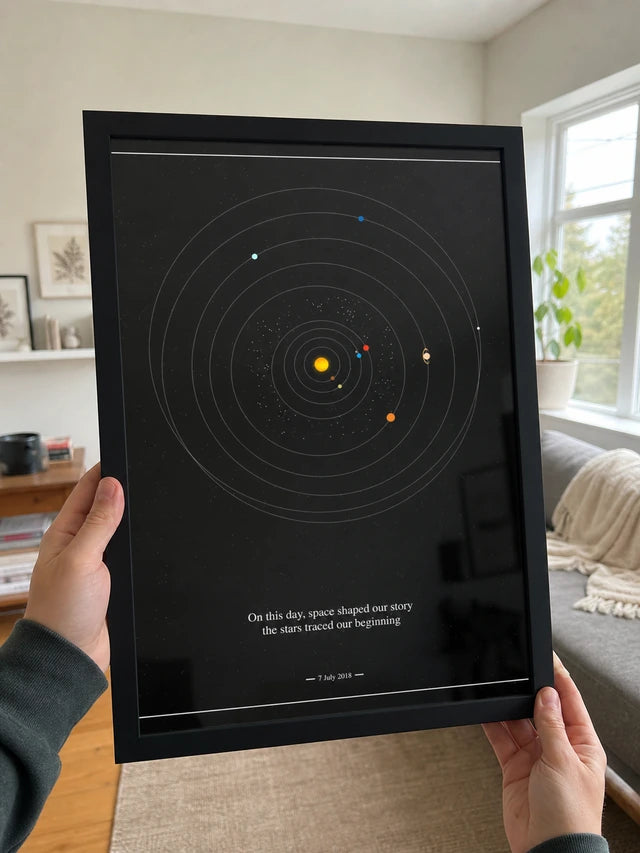
Some 2027 dates are already on the calendar for other reasons: a wedding, a due date, a move. You can see where the planets will stand on each one now: open Live View, pick a date and watch them move into place. Our guide to the solar system on the day you were born shows how to read one date's arrangement.
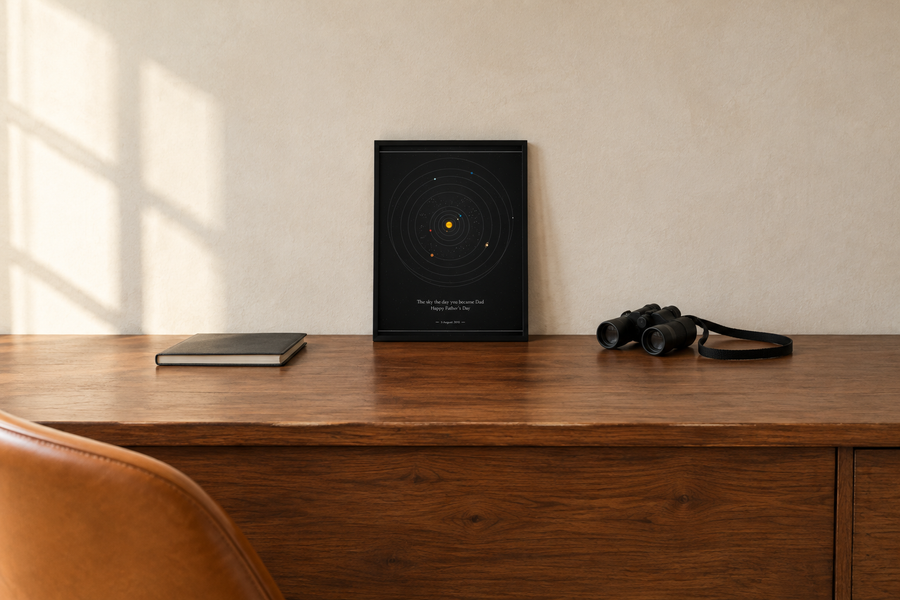
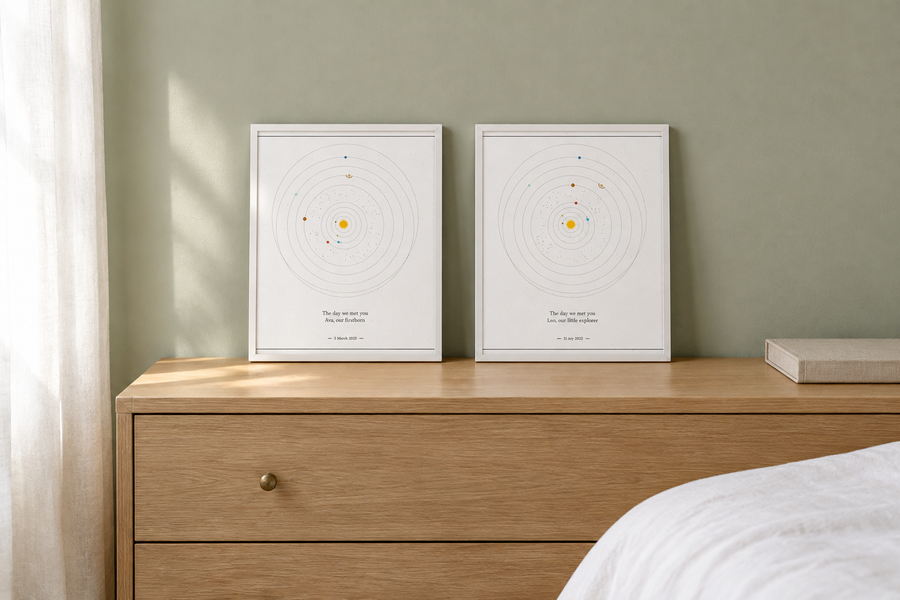
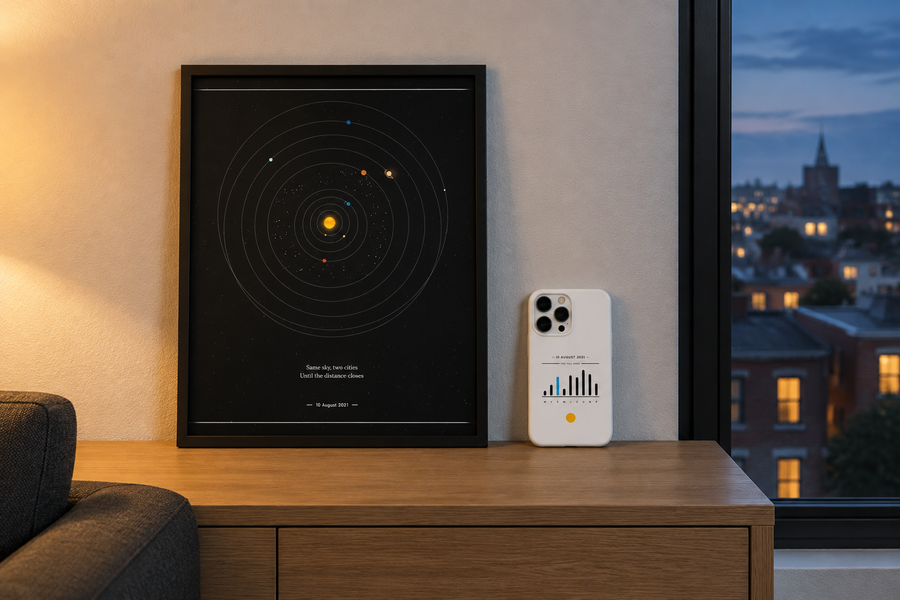
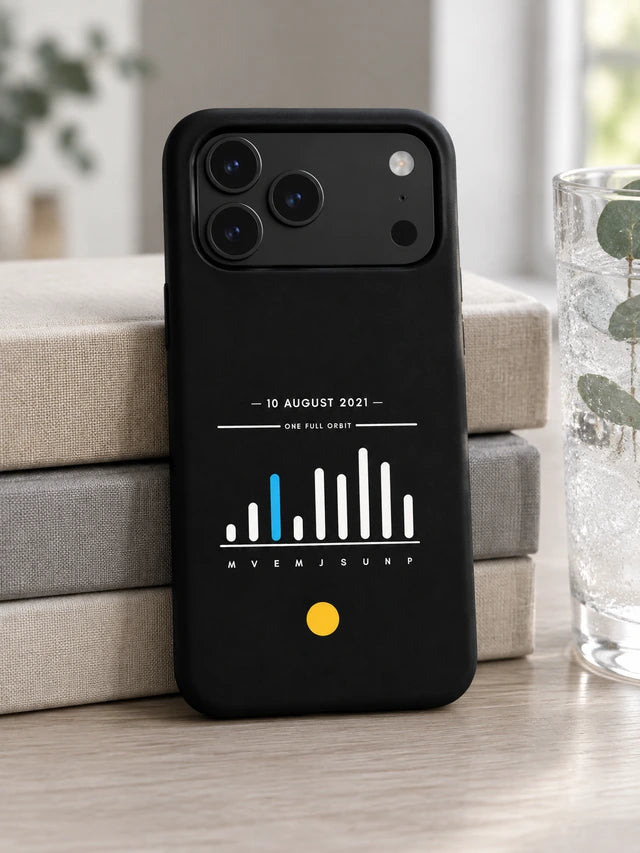
The Date Print shows the eight planets and Pluto on the date you choose, each in its direction from the Sun, calculated from NASA JPL's published orbital data. Future dates work too, so if a day in 2027 already matters, you can create your Date Print for it.
Eclipse data: NASA Goddard Space Flight Center, F. Espenak, solar eclipses 2021 to 2030 and lunar eclipses 2021 to 2030. Equinox and solstice times: US Naval Observatory. Planet positions calculated with JPL's DE421 ephemeris.