
Anniversary gifts by year: the traditional and modern list, and where it comes from
Anniversary gifts by year come in two lists. The traditional list gives a material for each year: paper for the first, cotton for the second, leather for the third, then wood at 5, tin at 10, silver at 25 and gold at 50. The modern list offers alternatives, such as clocks, china and crystal. Neither list is official.
Below is the full chart, built from four published lists, with a note on every row where they disagree. First, a short history, because where the list came from explains why the lists don't match.
Where does the anniversary gift list come from?
The oldest part of the list is the middle and the end. As TIME has reported, by the 18th century German friends might give a wife a silver wreath after 25 years of marriage, and a gold one at 50. In English-speaking countries the custom only starts to appear in the 1800s. The historian Stephanie Coontz places it in the Victorian era, when marrying for love was becoming the norm.
The earlier years filled in during the 19th century. TIME quotes an 1859 edition of the Old Farmer's Almanac: "one month from marriage makes a sugar wedding; one year makes a paper wedding." The same almanac gave wood at five years, tin at ten, silver at 25, gold at 50 and diamond at 75.
Etiquette books then grew the list, and they did not grow it the same way. John H. Young's Our Deportment, in its 1881 edition, names paper, cotton and leather for the first three years. Maud Cooke's Social Life (1896) runs to seventeen anniversaries and already has pearl at 30, coral at 35 and ruby at 40. A 1920 edition of Edith Ordway's The Etiquette of To-day starts with a cotton wedding and puts paper second.
Emily Post kept it short. Her Etiquette of 1922 lists eight anniversaries: paper, wood, tin, crystal, china, silver, gold and diamond, at 1, 5, 10, 15, 20, 25, 50 and 75 years. She also wrote that "the paper, wooden and tin wedding presents are seldom anything but jokes." The first-anniversary article has her list in full.
The year-by-year list is a 20th-century creation, and the trade had a hand in it. According to TIME, which cites the trade paper the Jewelers' Circular, the American National Retail Jewelers Association discussed adding to the common anniversaries at its 1922 meeting. One attendee pointed out that wooden and tin anniversaries came long before gold and diamond ones, and that a jeweler "derived very little profit until after he had waited 50 or 75 years." Over the next decade or so the association worked toward one list for jewelers across the US, heavy on precious stones and metals.
Many charts date the jewelers' finished list to 1937. We could not find that list itself, and the charts that cite it disagree about whether it became today's traditional column or the modern one. The earliest two-column list we could read in full is the Chicago Public Library's. Its reference librarians compiled a traditional and a modern list, last updated in 2000, from the World Almanac, the World Book Encyclopedia and a library journal.
Anniversary gifts by year: the chart
This chart compares four current lists: the Chicago Public Library's, Hallmark's, and the charts of two gift retailers. Where the lists that cover a year agree, the row has no note. Where they differ, the note says how. Older lists are mentioned only where they help explain a difference.
| Year | Traditional | Modern | Where lists disagree |
|---|---|---|---|
| 1 | Paper | Clocks | Some British lists, and at least one older American book, put cotton first and paper second. |
| 2 | Cotton | China | See year 1. |
| 3 | Leather | Crystal or glass | |
| 4 | Fruit or flowers | Appliances | The Chicago list gives linen or silk. |
| 5 | Wood | Silverware | |
| 6 | Iron | Wood | Some lists add candy. |
| 7 | Wool or copper | Desk sets | |
| 8 | Bronze | Linens or lace | Some lists add pottery. |
| 9 | Pottery | Leather | Some lists give willow; the Chicago list adds china. |
| 10 | Tin or aluminum | Diamond jewelry | |
| 11 | Steel | Fashion jewelry | |
| 12 | Silk or linen | Pearls or colored gems | The Chicago list gives silk alone. One retailer gives pearls or jade as the modern gift. |
| 13 | Lace | Textiles or furs | |
| 14 | Ivory | Gold jewelry | Hallmark gives gold jewelry as the gift. |
| 15 | Crystal | Watches | |
| 20 | China | Platinum | |
| 25 | Silver | Silver | |
| 30 | Pearl | Diamond | |
| 35 | Coral | Jade | The Chicago list gives coral or jade as the traditional gift. |
| 40 | Ruby | Ruby | |
| 45 | Sapphire | Sapphire | |
| 50 | Gold | Gold | |
| 55 | Emerald | Emerald | |
| 60 | Diamond | Diamond | Some older lists put diamond at 75. |
| 75 | Diamond or gold | Not listed | Hallmark's list stops at 60. |
Only some of the lists include the years in between (16 to 19, 21 to 24, and so on). The Chicago list gives a modern gift for every year to 50, and it reaches some surprising places: groceries for the 44th, and optical goods, such as a telescope or a microscope, for the 48th.
Which anniversary gifts do all the lists agree on?
Among the lists in the chart, wherever they cover a year, the traditional gifts agree at 1, 2, 3, 5, 7, 10, 11, 13, 15, 20, 25, 30, 40, 45, 50, 55 and 60. Over a longer stretch of time, even some of those moved. Some older lists put cotton first. Ruby, at 40, was wool in a 1921 etiquette book. Diamond sat at 75 in the 1859 almanac and in Post's 1922 list, though other books had already moved it to 60.
The steadiest entries are among the oldest: silver at 25 and gold at 50, which go back to the German wreaths, and wood and tin at 5 and 10, which were already in the 1859 almanac. Every list we checked, old or new, agrees on those four.
What is the difference between traditional and modern anniversary gifts?
The traditional column is mostly materials: paper, cotton, wood, tin. The modern column is mostly things you can buy: clocks, appliances, silverware, watches. In the early years the two columns differ almost everywhere. From the 40th to the 60th, they name the same gift: ruby, sapphire, gold, emerald, diamond.
Traditional or modern: which should you follow?
Neither, strictly. No one owns either list, and the people who wrote the early ones treated the first few years lightly. Post expected the paper, wood and tin gifts to be jokes. Crystal, at 15, was "the earliest that is likely to be taken seriously."
A practical approach:
- Use the list as a prompt, not a rule. Read both columns for your year and keep whichever suggests something the person would like.
- Take the material loosely. A wood year can be a carved spoon, a tree planted together or a weekend in a cabin. Tin can be a box of old letters.
- Follow tradition at the milestones. At 25 and 50, silver and gold have the longest history of any anniversary gifts, and both columns agree anyway.
- If a row is contested, choose the version you prefer. No list is more correct than another.
The milestone years
1st: paper
Paper has been the first anniversary gift in most American lists since at least 1859, and it suits a first year: light, personal, and easy to make your own. Our paper anniversary gift ideas cover twelve of them, from a letter to a photo book of the year.
5th: wood
The 1881 edition of Our Deportment said wooden-wedding presents could run "from a wooden paper knife or trifling article for kitchen use up to a complete set of parlor or kitchen furniture." The range is still about right.
10th: tin
Tin, often with aluminum as the alternative, has held its place at ten years in every list we checked. The modern column gives diamond jewelry instead.
25th: silver
The silver wedding is one of the oldest anniversaries on the list, and Post wrote that "silver is always serious." For ideas, see our 25th anniversary gift ideas.
50th: gold
Post called the golden wedding "a quite sacred event," most often marked with a large family dinner. Our 50th anniversary gift ideas include what children can give their parents.
60th and 75th: diamond
Whether diamond belonged to the 60th or the 75th was, in TIME's words, "unsettled" in the 19th century. Today's lists give it to the 60th.
When the material doesn't fit
Sometimes the year's material is wrong for the person. Pottery for someone with no shelf space, steel for someone who isn't into tools. One thing stays the same every year, whatever the chart says: the wedding date itself.
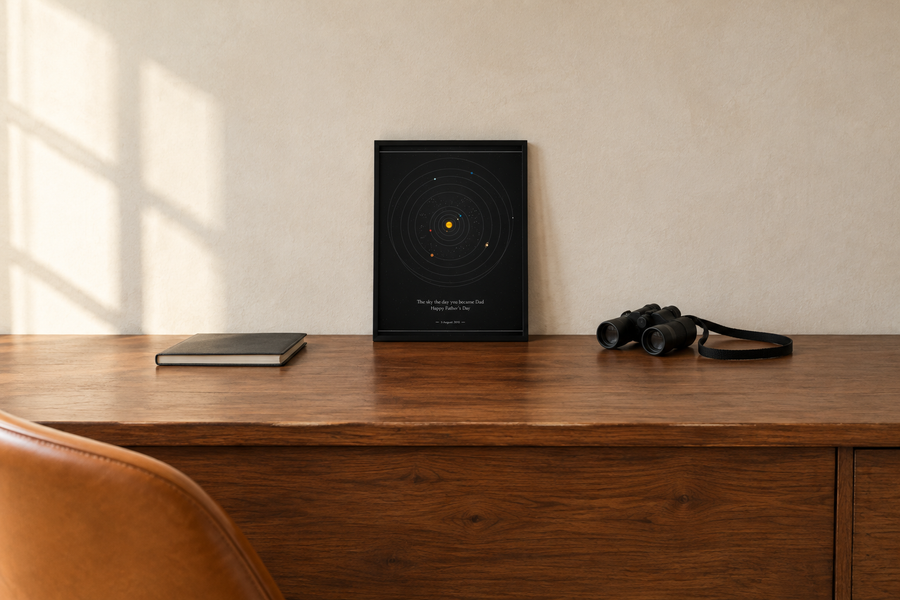
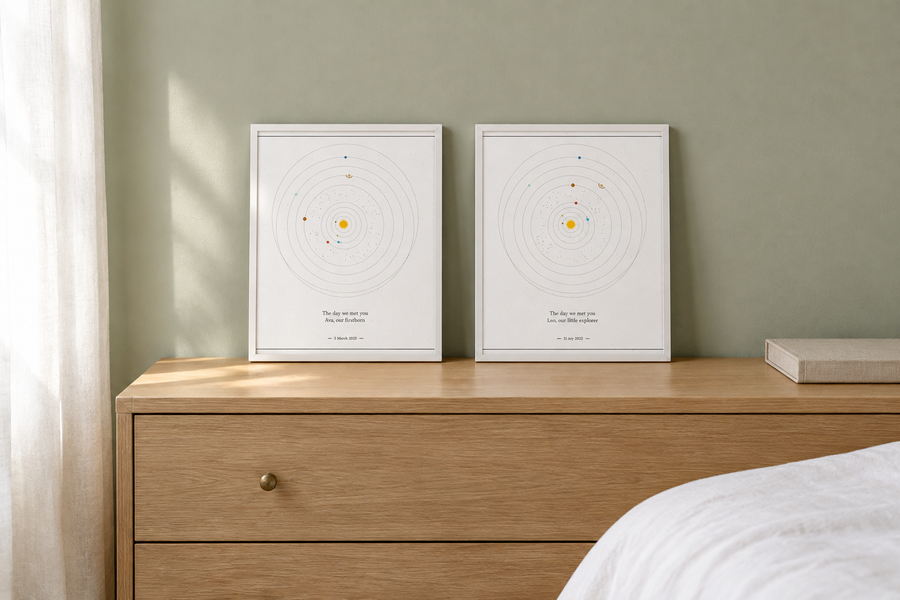
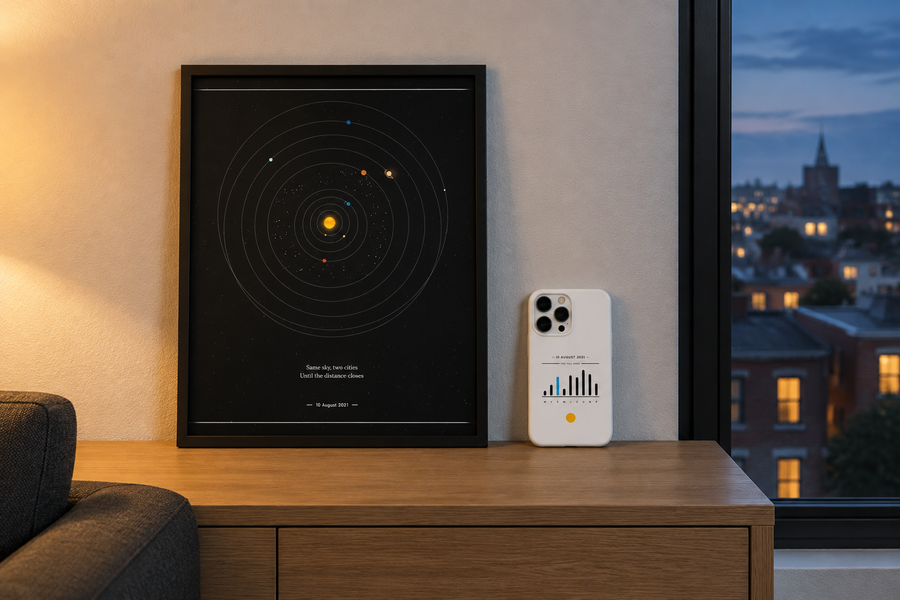
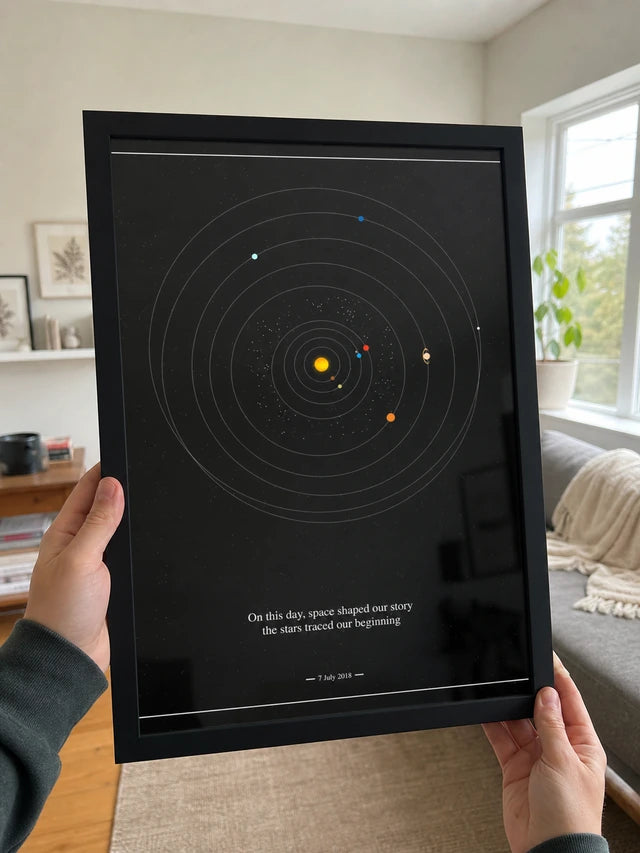
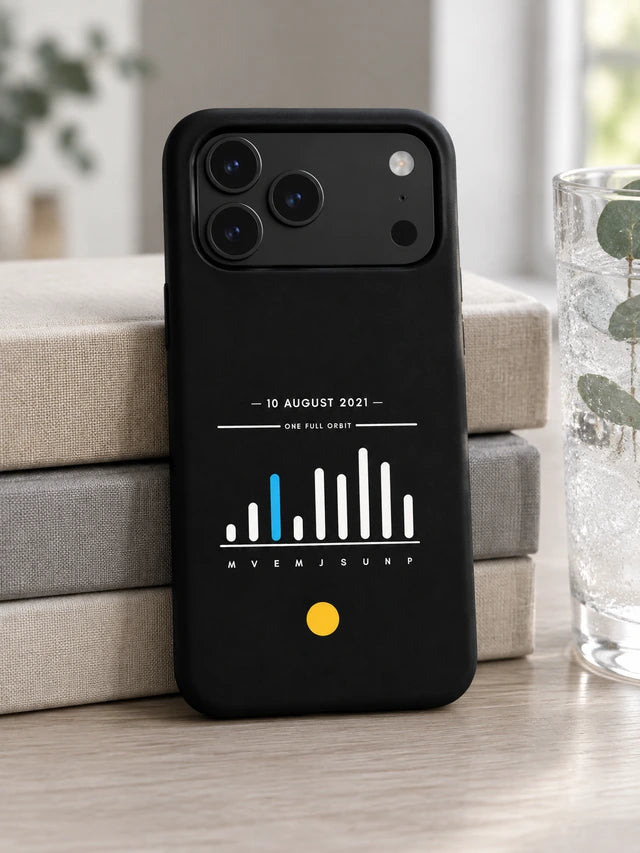
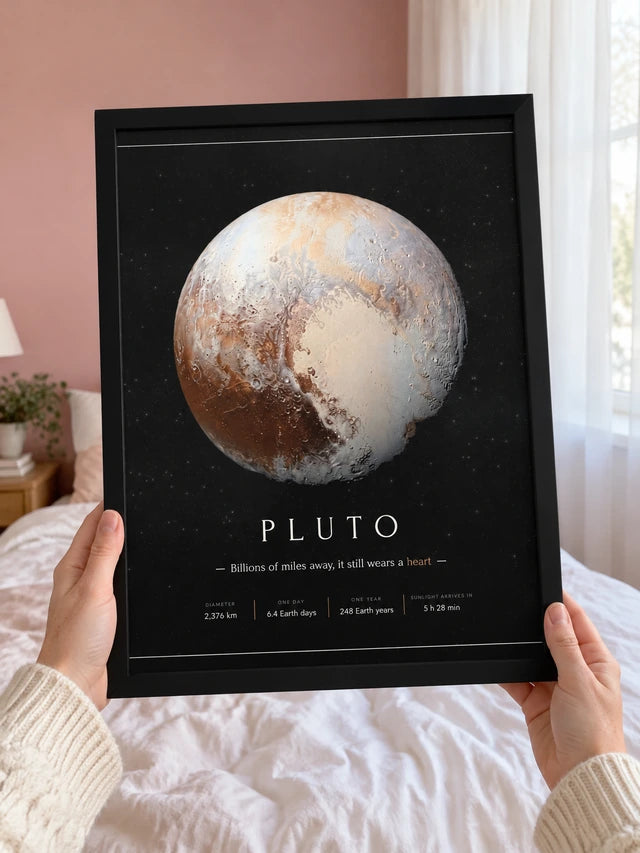
That is the idea behind the Date Print. It shows the solar system from above on a date you choose, with the Sun at the center and the eight planets and Pluto, each on its own ring, in the direction it lay from the Sun that day. A short message of your own sits beneath. For a first anniversary, the frameless print on premium matte paper also counts as a paper gift. For later years the date stays the same and only the words change: "Ten years under these planets."
A chart is a starting point
The lists were never handed down from one authority. They grew out of German silver wreaths, a farmer's almanac, etiquette writers and the jewelry trade, and they still disagree on some years. Pick the row that suits you, take the material loosely, and let the date do the rest. If the planets on your wedding day or the day you met feel like the right gift, start with your date on our anniversary gift page.