
Gifts for astronomy lovers: ideas for every kind of stargazer
Updated October 2026.
The best gifts for astronomy lovers match how they enjoy the sky. Someone who likes to go out and look wants better ways to see: good binoculars, a red flashlight, a star chart. Someone who loves to learn wants books, memberships and a local club. And almost anyone who loves space would treasure a night under truly dark skies.
This guide sorts the ideas that way, with honest advice on a first telescope, what North Americans can see this winter, and a free option at the end.
What do you get someone who loves to observe?
Binoculars, before a telescope
For a beginner, NASA's Night Sky Network recommends a good pair of binoculars for getting to know the sky, noting that their optics are almost always better than a similarly priced telescope's. The Smithsonian's National Air and Space Museum calls binoculars a good "first telescope": portable, able to reveal surprising detail on the Moon, and better than a telescope for some sights, such as star clusters and comets.
The two numbers on binoculars tell you what you're buying. A 10x50 pair magnifies 10 times and has lenses 50 mm across. The museum suggests 7x to 10x magnification and lenses at least 35 mm wide.
A red flashlight
It is the smallest gift here and one of the most used. White light from a flashlight or phone undoes night vision, and the National Park Service notes that eyes take 20 to 30 minutes to fully adjust to the dark. A red light lets them read a chart without starting over. Many headlamps have a red mode, which keeps both hands free.
A planisphere or a star atlas
A planisphere is a round star chart with a turning window: set the date against the time and it shows which stars are up. Each one is made for a band of latitude, so pick one that suits where they live. Someone further along will get more from a star atlas, a book of detailed charts to use at the eyepiece.
Is a telescope a good gift for a beginner?
It can be, but it is the gift most likely to end up in a closet. The Smithsonian's advice for buying a first telescope is direct: telescopes don't teach you the night sky, and one bought too early can frustrate. If they are new to it, binoculars and a chart come first.
If you do buy one, a few points from the same guide:
- Size matters, magnification doesn't. A telescope's most important number is the diameter of its main lens or mirror, because that sets how much light it gathers. Skip any telescope sold on its magnifying power.
- Four to six inches goes a long way. A telescope with a main mirror or lens of that size shows a great deal.
- A steady mount. A shaky mount spoils every view. A Dobsonian, a telescope on a simple pivoting base, is a popular first choice, and a hand-adjusted mount is a sound start before anything electronic.
- Set it up indoors first. The first assembly should happen in daylight, at home, with the instructions. Then line up the small finder scope with the main tube before the first night out.
The museum also notes there is no single best telescope: the right one is the one they will actually use.
What do you get a stargazer who already has a telescope?
Gear is personal, so unless they have named a particular eyepiece or filter, give them more to point it at. Turn Left at Orion by Guy Consolmagno and Dan M. Davis (Cambridge University Press, fifth edition 2018) does what its subtitle says: hundreds of night sky objects to see in a home telescope, and how to find them. Or take the telescope somewhere truly dark (see the experiences below).
Gifts for the one who reads and learns
The Observer's Handbook. The Royal Astronomical Society of Canada has published it since 1907. The society calls it the standard North American reference for data on the sky, and a USA Edition uses American cities for its examples. A new edition each year makes it a gift that can become a tradition.
A Planetary Society membership. The Planetary Society offers gift memberships. Members receive The Planetary Report magazine (digital or print), join an online community with live events and free classes, and can have their name sent to space on select missions.
A local astronomy club. NASA's Night Sky Network gives this as its top recommendation for a new skywatcher: members learn the sky together and can borrow telescopes. In the US, its club finder searches by city or zip code. In Canada, the Royal Astronomical Society of Canada has 30 local Centres from St. John's to Victoria.
Which experiences make good astronomy gifts?
A planetarium show or a public observatory night. Many science museums have a planetarium, and local observatories and astronomy clubs hold regular public stargazing nights. The Smithsonian points out these are an ideal time to try different telescopes and ask advice before anyone buys one.
A trip to a dark-sky park. In the US, Big Bend National Park in Texas became an International Dark Sky Park in 2012, and Great Basin in Nevada in 2016. In Canada, the Royal Astronomical Society of Canada keeps a list of designated Dark-Sky Preserves, among them Point Pelee in Ontario (2006), Kejimkujik in Nova Scotia (2010) and Jasper in Alberta (2011). Check winter access with the park before you plan.
A planned night out. Even a promise works as a gift: a thermos, a blanket and a date in the calendar for a meteor shower. This winter has two good ones, below, and our meteor shower calendar has the full year.
What's in the sky this winter, November 2026 to January 2027?
Here is what a new pair of binoculars or a telescope can find this season. Times are local clock time at about 40 degrees north (Philadelphia, Denver, northern California) and agree within minutes in the Eastern and US Pacific time zones. Farther north or south they shift. British Columbia stopped turning its clocks back in November 2026, so its times run an hour later than US Pacific this winter.
| What | When | Where to look |
|---|---|---|
| Venus, the morning star | All season, rising around 3:30 to 4:30 am from mid-November; at its brightest in late November | Southeast, before dawn |
| Saturn | Every evening; it sets around 1 am in mid-December and around 11 pm in mid-January | Southeast to south after dark, moving to the southwest by late January |
| Mars and Jupiter | Just over a degree apart in Leo in mid-November 2026, before dawn. They drift apart and rise earlier each night: by mid-January Jupiter rises around 7:30 pm and Mars around 8:30 pm | High in the south before dawn; in the east by January evenings |
| Geminid meteor shower | The night of December 13 to 14, 2026 | Anywhere in the sky; best from late evening to before dawn |
| December solstice | December 21, 2026, at 3:50 pm Eastern (12:50 pm US Pacific, 1:50 pm in British Columbia) | The longest nights of the year, for any of the above |
| Quadrantid meteor shower | The night of January 3 to 4, 2027 | Northeast, in the hours before dawn |
The International Meteor Organization calls the Geminids "the best and most reliable" of the major annual showers, with up to about 150 meteors an hour under ideal conditions. In 2026 the Moon is a crescent that sets around 9 pm, leaving the rest of the night dark, and the shower's radiant climbs highest around 2 am.
The Quadrantids' short peak falls on the evening of January 3, 2027 (about 10:30 pm Eastern, 7:30 pm US Pacific), while their radiant is still near the northern horizon. Watch from about 3 am until dawn on January 4, once it has climbed, though rates will have eased. A slim crescent Moon doesn't rise until about 5 am.
And a telescope opened in December has good timing: Jupiter reaches opposition, when it is up all night, on February 10, 2027, and Mars on February 19.
Space art for the wall, and for their pocket
Some astronomy lovers want the sky indoors too. These are ours.
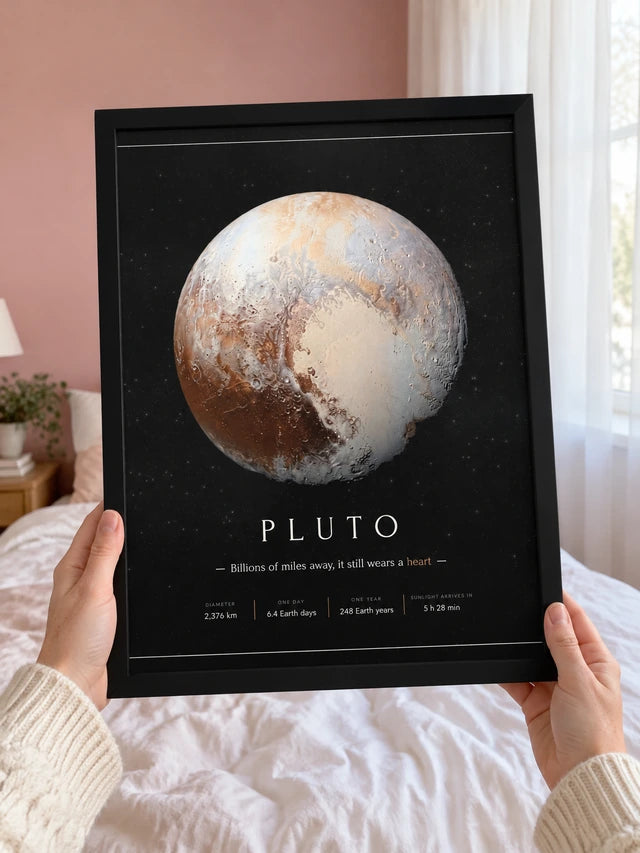
Planet Posters. Nine single-world posters, Mercury to Pluto. Each prints four numbers: the world's diameter, the length of its day, the length of its year, and how long sunlight takes to reach it. For someone who has just seen its rings for the first time, the Saturn poster is the obvious one.
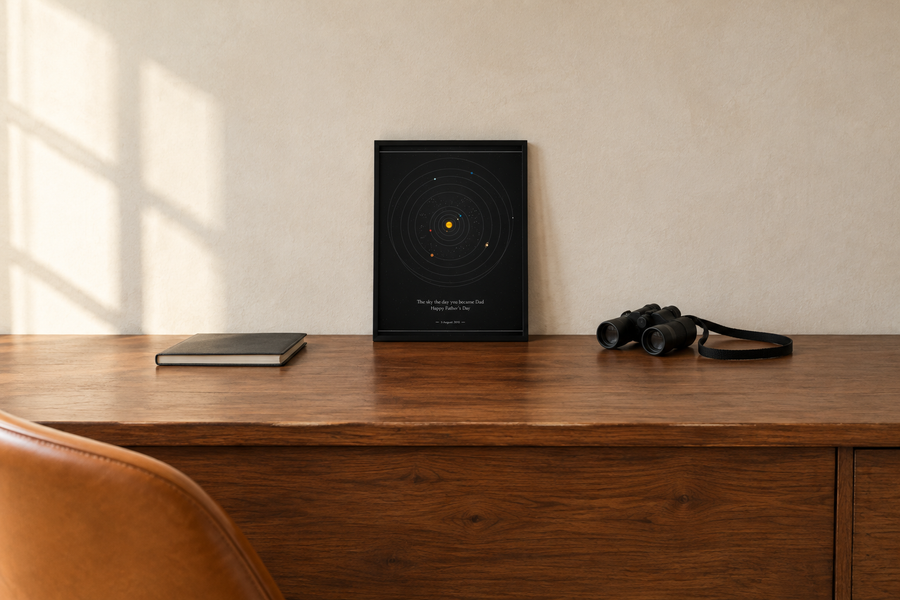
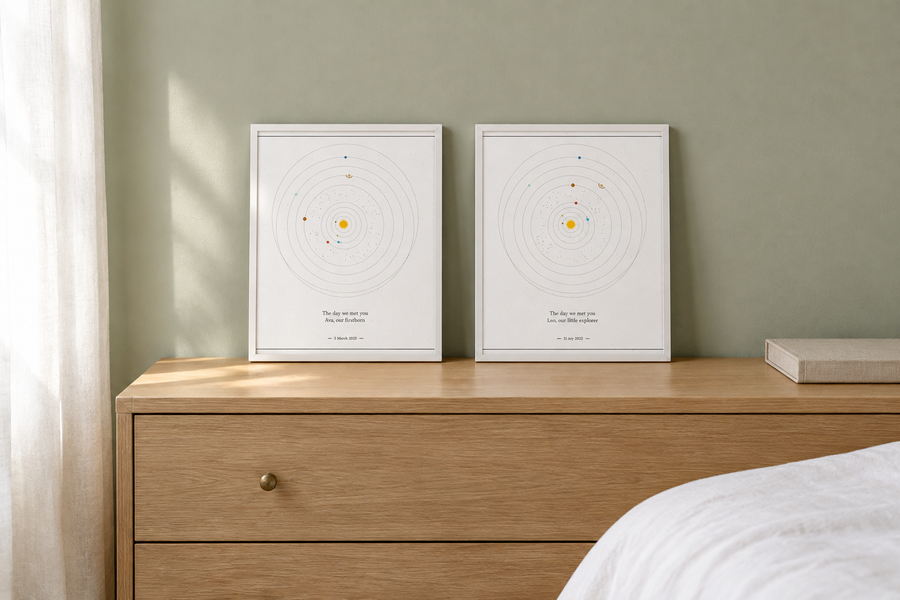
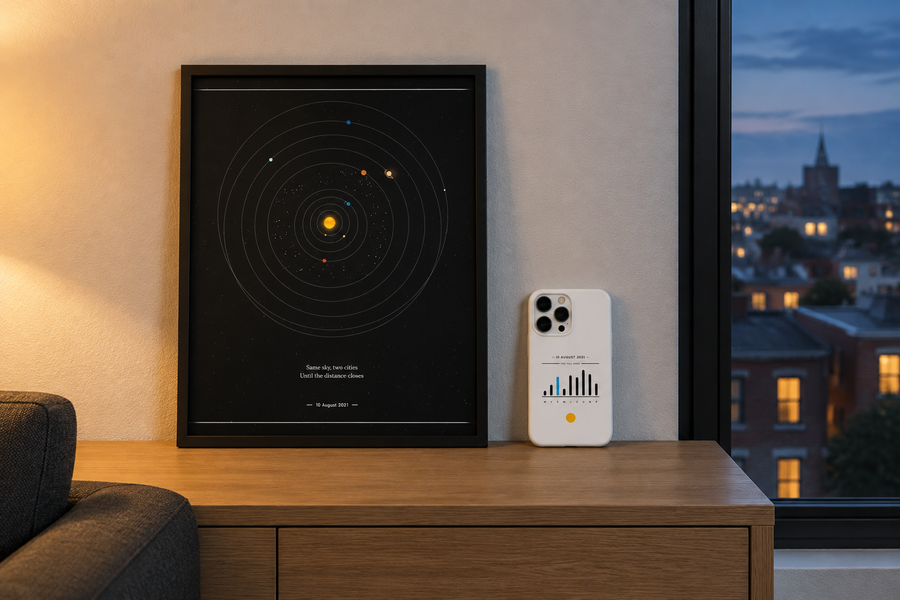
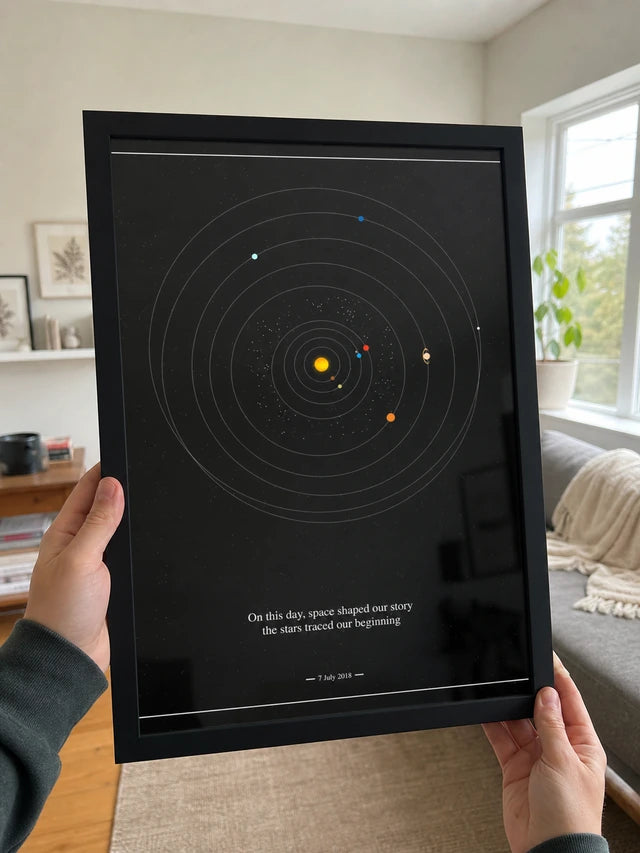
The Date Print. For an astronomy lover: the solar system seen from above, with the eight planets and Pluto where they stood on a date that matters to them, a birthday, a wedding, the night they first saw Saturn. Each planet's position is calculated from NASA JPL's published orbital data, and you can compare it with JPL's own simulator. Our guide to the solar system on the day you were born shows what one date looks like. If you're weighing it against a constellation chart, see star map vs planet print.
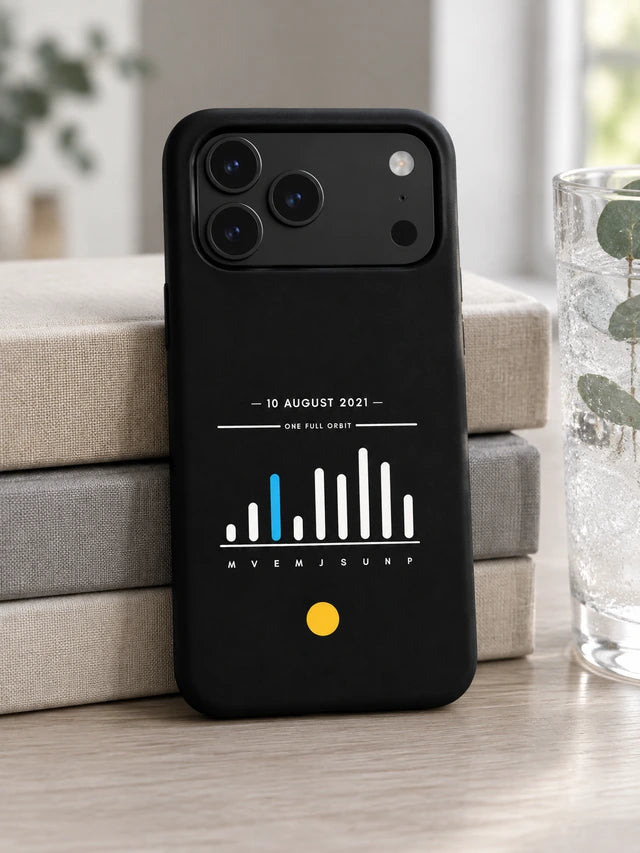
The Sky Code Case. The same idea in their pocket: a date written as nine bars, one per world, each showing how far round the Sun that world had traveled. Earth's bar is blue and the Sun is yellow. It is a matte tough case in Black or White for many iPhone and Samsung models, for dates from 1900 to 2050.
What's a free or last-minute astronomy gift?
Live View, free. On Live View you choose a day that matters, add a few words and send it. They open the link and watch the planets move to where they stood that day. No app or account needed.
A digital Date Print. The digital file is emailed within 24 to 48 hours, so it works even when shipping is too late.
Anything with no shipping. A club membership, planetarium tickets, a Planetary Society gift membership, or a handwritten promise of a Geminid night out.
When should you order astronomy gifts for the holidays?
| Gift | How long it takes | Order by |
|---|---|---|
| The Date Print and Planet Posters, and Sky Code Cases to the US | Made to order: the Date Print in 2 to 5 business days, then free shipping to the US and Canada. Most orders arrive within 1 to 2 weeks. | Thursday, December 3, 2026 |
| Sky Code Cases and white-framed prints shipping to Canada | Also made to order, with free shipping. Both are made in the US, so orders to Canada cross the border and need more time. Black-framed and frameless prints for Canada are made in Canada and follow the date above. | Friday, November 20, 2026 |
| The Date Print as a digital file | Emailed within 24 to 48 hours | The last-minute option |
| Live View | Instant | Any time, free |
| Binoculars or a telescope | Depends on the seller | Early enough to set it up indoors, in daylight, before the first clear night |
For more ideas organized by occasion rather than hobby, see our gift ideas by moment.
A gift that points them back at the sky
The best astronomy gifts send someone outside: a pair of binoculars on a clear night, a dark park, a shower worth staying up for. If you'd also like to give them a date they can keep, the Date Print shows where every planet stood on it, in Black or White, from 8x10 to 16x20 inches. Create your print, and give them one more reason to look up.